
Posted by: Skin And Cancer Institute in Medical Dermatology
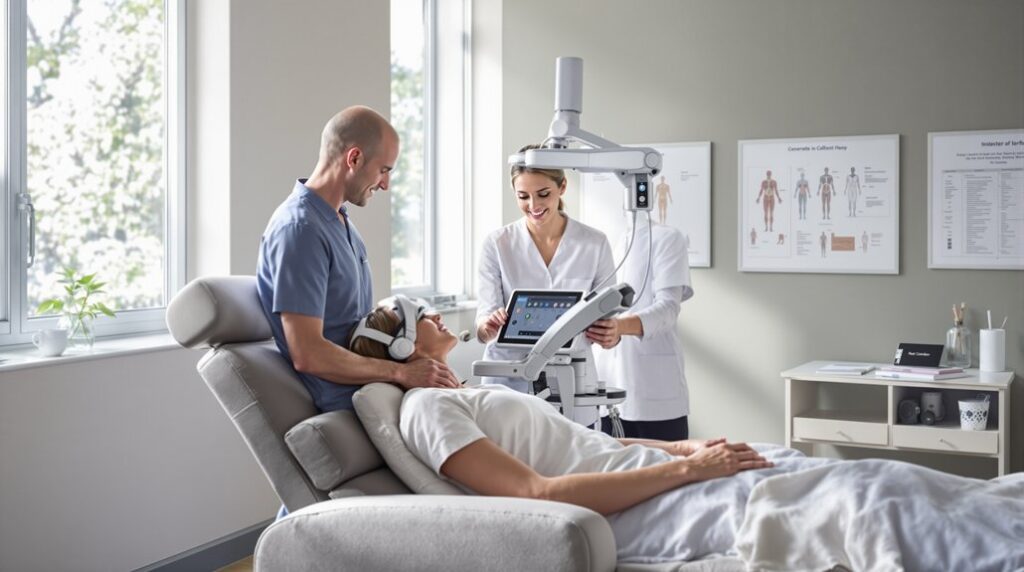
Integrating SRT into your practice requires specific equipment (110-240V power, 30”x30” footprint), regulatory compliance with FDA standards, and dedicated staffing (2.0 FTE nurses, 1.0 FTE physician). We’ve found proper implementation yields impressive outcomes—98.9% cure rates for non-melanoma skin cancers at 24-85 months. Patient selection is essential, with ideal candidates having basal or squamous cell carcinomas. The right preparation guarantees you’ll achieve the exceptional results that make SRT a valuable practice addition.
Key Takeaways
- SRT equipment requires dedicated space (30”×30” footprint), specific power (110-240V with 20-amp circuit), and controlled environmental conditions (50-86°F, 30-70% humidity).
- Staffing should include at least 2.0 FTE Registered Nurses and 1.0 FTE Physician with specific training in SRT protocols and procedures.
- Training must incorporate multi-disciplinary simulation exercises, regular assessments, and cross-training to ensure team readiness and error prevention.
- Modern SRT protocols achieve 98-99% cure rates for non-melanoma skin cancers with proper patient selection criteria and treatment planning.
- Implementation requires regulatory compliance with FDA standards, comprehensive documentation systems, and established peer review processes for quality assurance.
Understanding SRT Technology Requirements

Four key technical requirements must be addressed before integrating Superficial Radiation Therapy (SRT) into your dermatology practice. First, guarantee your facility can handle the electrical demands—SRT technology requires 110-120V or 220-240V power with a dedicated 20-amp circuit breaker allowing for periodic high current draws of up to 20 amps.
Second, confirm you have adequate space for the equipment specifications: a 30” x 30” footprint plus clearance for the arm’s vertical (57”) and horizontal (49”) travel. The system weighs 350 lbs total.
Third, verify your facility maintains appropriate environmental conditions: 50°F-86°F with 30-70% non-condensing humidity.
Finally, prepare for safety compliance with FDA and ISO/CE standards, including proper radiation shielding and control console placement. Establishing standard operating procedures for setup verification and quality assurance is essential to maintain treatment unit accuracy and patient safety.
Assessing Your Practice’s Clinical Needs
When evaluating your practice’s readiness for SRT integration, a thorough needs assessment must first identify your specific clinical requirements. Our technology assessment should consider your patient volume, case mix, and anatomical sites treated most frequently.
We’ve found that different treatment locations require specific verification protocols—70.2% of institutions require verification images for brain SRT, while 95.4% need them for lung SBRT. Your practice evaluation must account for these differences.
Additionally, consider your team’s capacity for multidisciplinary collaboration, as shared decision-making is essential for proper disease staging. The most popular machines currently utilized are Varian Truebeam STX® and Cyberknife®, which may influence your equipment selection. You’ll need to assess whether your current staff can manage site-specific technical approaches and determine if your facility can support the advanced quality assurance procedures that exceed conventional radiotherapy requirements.
Regulatory Compliance and Safety Protocols

Implementing SRT technology requires strict adherence to a thorough regulatory framework designed to protect both patients and providers. At Skin and Cancer Institute, we recognize that maneuvering through these requirements is essential for successful integration into your dermatology practice.
Our experience has shown that regulatory compliance involves multiple layers, including equipment certification, provider credentialing, and ongoing quality assurance monitoring. These regulatory frameworks guarantee that SRT delivery meets established safety standards while maximizing therapeutic outcomes.
We recommend developing extensive safety protocols that address patient selection criteria, treatment planning procedures, and adverse event management. Additionally, maintaining detailed documentation of all treatments and quality checks provides protection against liability concerns. Practices should establish a peer review system for SRT cases to ensure clinical excellence and continuous improvement in patient outcomes. Implementing Superficial Radiotherapy can achieve high success rates of 84-99% for basal and squamous cell carcinomas while preserving healthy surrounding tissue.
Staffing Requirements for SRT Implementation
Successful SRT integration requires a strategic staffing approach that balances clinical expertise with operational efficiency. Our implementation data shows that proper staffing ratios are essential—we’ve found that maintaining at least 2.0 FTE Registered Nurses and 1.0 FTE Physician oversight creates the foundation for effective SRT delivery.
Role responsibilities must be clearly defined, with dedicated staff completing specific training in SRT protocols. We’ve observed that practices struggling with implementation often have inadequate staffing levels, with the average facility operating 12-22% below ideal staffing ratios. Rural facilities have been granted a longer implementation timeline of up to five years to meet the same requirements due to their unique staffing challenges. To guarantee success, we recommend:
- 24/7 professional access with consultation availability
- Minimum of 3.48 hours per resident day for total nurse staffing
- Licensed clinicians supervising all treatment activities
- Regular training updates for all team members
Essential Training Procedures for Clinical Teams

Thorough training sits at the heart of any effective SRT program, building upon the proper staffing foundation previously outlined. We implement a multi-disciplinary approach focused on Crew Resource Management principles that emphasize proactive error management rather than reactive responses to patient harm.
Our training protocol incorporates high-fidelity simulation exercises where clinical teams practice responding to infrequent scenarios without patient risk. These sessions develop competencies through real-time performance evaluation and targeted feedback. Creating a dedicated training environment away from clinical units allows teams to focus entirely on learning without the distractions of everyday patient care responsibilities.
Team communication forms the cornerstone of our training, with specific protocols that flatten hierarchies and encourage cross-specialty familiarity. We conduct monthly training exercises with formal assessment and require recurrent training annually to reinforce key concepts.
Cross-training between team members builds role flexibility, ensuring everyone can contribute confidently during critical situations regardless of their primary specialty.
IGRT Integration for Treatment Accuracy
Image-guided radiation therapy (IGRT) represents a cornerstone technology for practices seeking to elevate their SRT precision capabilities. We implement a five-step workflow that includes initial imaging, pre-treatment verification, and post-treatment confirmation to maximize geometric accuracy while maintaining workflow efficiency.
Our approach integrates advanced image registration methods with systematic error minimization protocols. By comparing treatment positioning with reference simulation images, we achieve superior patient positioning and reduce geometric uncertainties. This precision allows for potentially reduced treatment margins while guaranteeing target coverage.
When implementing IGRT, we recommend evaluating both online and offline correction methodologies based on your specific clinical scenarios. While online methods provide immediate verification, they extend treatment duration and increase radiation exposure. The introduction of mid-treatment imaging helped address unpredictable patient motion during treatment delivery, further improving accuracy. Technology integration should prioritize equipment compatibility and staff training to facilitate seamless adoption of these advanced treatment techniques.
Optimal Treatment Delivery Techniques

When implementing SRT in your practice, ideal treatment delivery techniques serve as the foundation for clinical success and patient outcomes. We’ve found that maximizing fractionation techniques is essential—delivering one to five high-dose sessions rather than conventional multi-week schedules improves patient convenience without compromising efficacy.
Precision targeting requires sub-millimeter accuracy through specialized immobilization methods. Whether you’re utilizing frame-based or frameless approaches, consistent patient positioning is critical. We recommend implementing multiple arc delivery techniques to enhance dose conformity while protecting surrounding tissue. A sophisticated 360° gantry rotation enables treatment from optimal beam angles, significantly improving dose distribution around complex target volumes.
Our workflow incorporates thin-slice MVCT imaging during planning and pre-treatment verification to address positioning challenges. This hybrid approach, fusing MVCT with MRI, guarantees accurate target delineation. Remember that specialized planning software for your specific delivery platform is necessary to achieve ideal dose distributions.
Patient Selection and Clinical Applications
We’ve found that selecting ideal candidates for SRT requires careful evaluation of tumor characteristics, with smaller, superficial lesions demonstrating higher cure rates approaching 98% when proper selection criteria are applied. Our multidisciplinary approach prioritizes basal cell carcinoma and squamous cell carcinoma as primary indications, particularly for head and neck lesions which constitute 80% of treated cases. Retrospective analyses reveal that appropriately selected patients treated with SRT experience low recurrence rates comparable to Mohs surgery. While SRT excels in these applications, some patients may benefit from alternative approaches such as targeted therapy which offers precision treatment for specific genetic mutations in skin cancer cells. Treatment protocols must be disease-specific, excluding cases with perineurial invasion, cutaneous T-cell lymphomas, and Merkel cell carcinomas which require alternative radiation therapy approaches.
Ideal Candidate Criteria
Selecting appropriate candidates for Superficial Radiation Therapy (SRT) requires careful evaluation of multiple clinical factors to guarantee ideal treatment outcomes. Our ideal candidate characteristics include patients with non-melanoma skin cancers, particularly basal cell and squamous cell carcinomas classified as Tis, T1, or T2 lesions. SRT is especially beneficial for patients seeking a non-invasive option as an alternative to surgical procedures.
Patient selection criteria focus on tumors smaller than 2.0 cm with well-defined borders, especially those located in the head and neck region where 80% of SRT treatments occur. We’ve found SRT particularly valuable for patients medically unsuitable for surgery, those wishing to avoid surgical scars, or cases involving anatomically challenging locations like the nasal tip or ala. At the Skin and Cancer Institute, we carefully evaluate each case to determine if SRT offers the best treatment path compared to surgical alternatives.
Disease-Specific Treatment Protocols
Our disease-specific treatment protocols for SRT build upon proper candidate selection by establishing standardized approaches for different non-melanoma skin cancers. We’ve developed thorough disease management strategies that account for both visceral manifestations and neurological involvement limitations.
For Type 1 Gaucher disease, we implement complete SRT protocols with oral daily maintenance medications, which have demonstrated excellent reversibility of non-neurological symptoms. However, we recognize that Types 2 and 3 require modified approaches focusing solely on non-neurological symptom control. It’s important to note that SRT is not approved for patients under 18 and pregnant or breastfeeding women.
Treatment response evaluation includes mandatory tracking of hemoglobin, platelet counts, and organ volumes through imaging. We monitor key biomarkers including chitotriosidase, CCL18-PARC, and ACE serum markers to assess efficacy. This structured monitoring guarantees our protocols deliver ideal outcomes while meeting documentation requirements for the annual reauthorization process.
Multidisciplinary Case Selection
Successful integration of Superficial Radiation Therapy (SRT) into dermatology practice requires robust multidisciplinary case selection protocols. At our institute, we’ve established extensive selection criteria that prioritize patients with irreversible conditions requiring intervention while excluding decisions based on demographics or personal characteristics.
Our multidisciplinary collaboration brings together dermatologists, radiation oncologists, and pathologists to evaluate each case through structured forums. We present patients after initial evaluation, analyzing disease status and discussing individualized treatment approaches. This team-based approach guarantees treatment decisions align with national standards while incorporating patient engagement in care discussions. As recommended in HCC management, the involvement of multidisciplinary teams is essential for determining appropriate treatments based on individual patient characteristics.
We’ve found this framework enriches clinical interpretation and optimizes outcomes through personalized therapy selection. By involving the right specialists and maintaining regular communication, we’re able to provide patients with timely, evidence-based SRT treatments tailored to their specific needs.
Measuring Treatment Outcomes and Success Rates
When evaluating SRT integration into your practice, success metrics provide essential benchmarks for performance assessment. Our outcome analysis confirms impressive results, with modern SRT protocols achieving cure rates of 98.9% at 24, 60, and 85 months. These figures now rival Mohs surgery in contemporary clinical practice.
We’ve documented that image-guided SRT delivers particularly robust outcomes, with 99.3% cure rates across multiple studies. Success metrics correlate with proper technique—maintaining 5-15mm treatment margins, appropriate fractionation with doses under 400cGy, and precise anatomical targeting. Ultrasound imaging enhances treatment precision by allowing visualization of tumor depth up to 6mm.
Long-term tracking remains vital, as recurrence patterns typically show 1.9% at 2 years, increasing to 5% at 5 years. For patients with underlying conditions that make surgery risky, SRT offers an effective non-surgical alternative that preserves healthy tissue while delivering therapeutic radiation doses. By implementing these evidence-based protocols, you’ll join us in delivering exceptional outcomes for your patients.
Frequently Asked Questions
What Is the Average Return on Investment for SRT Equipment?
We’re seeing impressive ROI with our SRT equipment’s cost effectiveness, breaking even at just 2-2.5 patients monthly. The equipment’s durability contributes to strong long-term returns for our dermatology community.
How Does SRT Compare With Mohs Surgery for Patient Satisfaction?
We’ve found mixed satisfaction data between SRT and Mohs. While SRT provider surveys show higher SRT satisfaction, dermatology clinics report 94% Mohs satisfaction for cosmetic outcomes. Patient preferences often depend on treatment experiences.
Can SRT Equipment Be Leased Rather Than Purchased?
Yes, we offer SRT equipment leasing options with significant cost benefits, including lower initial investment and potential tax advantages while maintaining access to this advanced treatment technology for our patients.
What Insurance Reimbursement Rates Can Practices Expect for SRT Procedures?
We typically see SRT reimbursement ranging from $200-450 per treatment session. Insurance coding varies by carrier, and practices should anticipate reimbursement challenges during the initial implementation phase of superficial radiation therapy.
How Long Does It Take to Achieve Proficiency in SRT Procedures?
We’ve observed most practitioners achieve SRT proficiency within 4-6 weeks of training. Skill acquisition progresses through manufacturer certification and supervised clinical application before independent treatment delivery is recommended.
Conclusion
We’ve found SRT to be a valuable addition to our multi-location practice. With proper equipment investment, staff training, and adherence to regulatory protocols, practices can achieve the 95%+ cure rates reported in clinical literature. Our outcomes data confirms that SRT offers an effective non-surgical option for appropriate patients, particularly those with comorbidities or lesions in cosmetically sensitive areas.